Study
69 menopausal women aged 50-65 participated in the study. They experienced at least five hot flashes per day. For eight weeks, they took a tablet containing 280 milligrams of Salvia officinalis extract every day. There was no placebo group.
If you dry sage leaves yourself and grind them into a powder, you need about one gram to ingest the same amount of active substances as are found in 280 milligrams of A. Vogel extract. That's half a teaspoon.
Thujone
A. Vogel's Salvia extract has been purified of thujone. Salvia officinalis contains small amounts of alpha- and beta-thujone. In high concentrations, alpha-thujone is particularly toxic, and to a lesser extent beta-thujone.
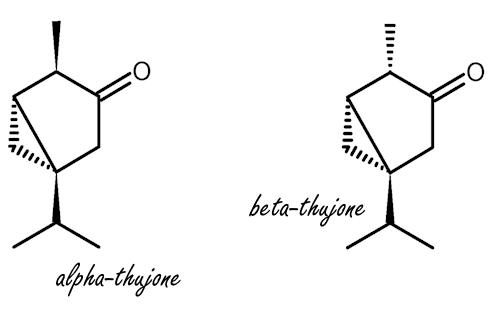
It is inconceivable that this would happen to people consuming dried Salvia officinalis. It contains at most 1 to 3 milligrams of thujone. However, to avoid trouble with governments, consumer organizations, and influencers, the Vogel group has removed thujone from its Salvia extract as a precaution. In many countries, products containing significant amounts of thujone are not allowed on the market.
Salvia lavandulifolia, the Southern European variant of Salvia officinalis, contains hardly any thujone. Even if you brew tea from Salvia officinalis with water that is no warmer than 70-90 degrees, it contains practically no thujone. Cold-brewed sage tea contains absolutely no thujone.
Results
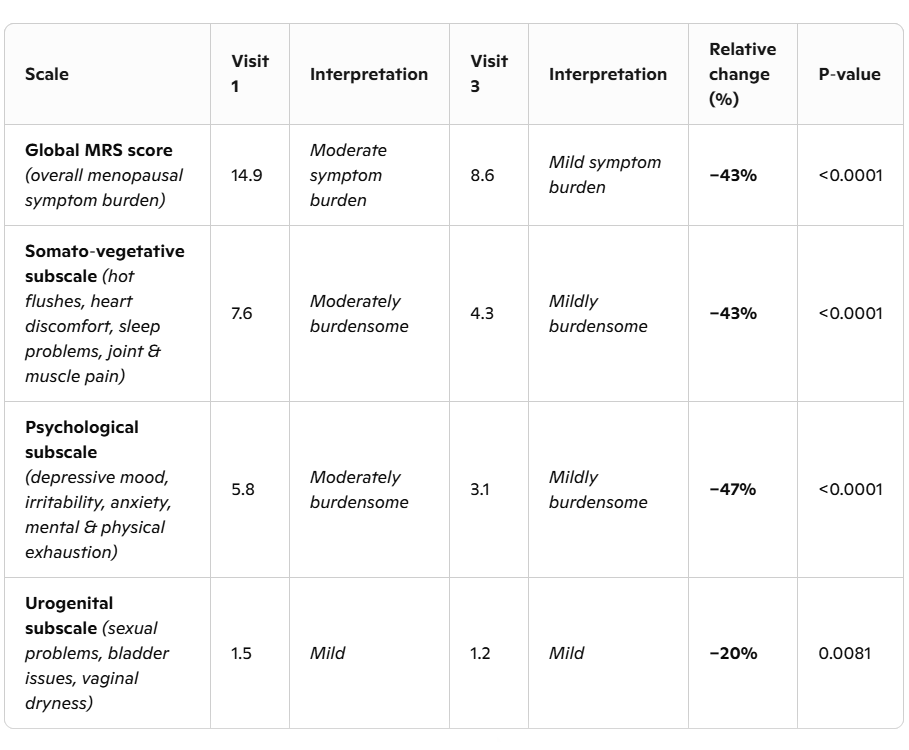
After 8 weeks of supplementation, the number of hot flashes had decreased by 81 percent and the hot flashes lasted shorter. The average severity of the hot flashes decreased from 'moderate' to 'mild'.
Click on the tables below for a larger version.

Mechanism
Hot flashes occur when the part of the hypothalamus that regulates body temperature no longer functions properly due to the loss of estradiol.
Carnosic acid, carnosol, rosmarinic acid, and 1,8-cineol in Salvia officinalis inhibit the enzyme acetylcholinesterase, causing the activity of acetylcholine in the brain to increase. As a result, the hypothalamic thermostat starts working better again.
Conclusion
According to the researchers, their study has provided "a scientific rationale for sage's use in folk medicine, offering a valuable option for patients and healthcare providers seeking alternative approaches to treatment of menopausal hot flashes and climacteric complaints."
"Further rigorous research to confirm the findings is suggested."
That's correct, of course.