![According to a somewhat older human study, supplementation with an extract of Salvia officinalis [better known as sage] can significantly improve the cognitive abilities of people with a moderate form of dementia. The dose required for this is entirely reasonable.](plaatjes/salvia-officinalis-cognition-0.gif)
Study
The Iranians divided the subjects into two groups, a placebo group and a supplementation group. The placebo group took 60 drops daily without bioactive substances. The supplementation group took drops containing an alcohol extract of Salvia officinalis.
We estimate that the drops contain approximately the same amount of bioactive substances as are present in capsules containing 300 to 600 milligrams of solid extract with a concentration somewhere between 1:5 and 1:10. We must admit that this estimate is on the rough side.
Mechanism of action
The researchers suspect that Salvia officinalis contains substances that stimulate both the 'fast' nicotinic and the 'slower' muscarinic acetylcholine receptors.
Via nicotinic receptors for acetylcholine, Salvia officinalis extract could stimulate attention, alertness, and working memory. Via the muscarinic receptor types, the extract could facilitate learning processes.
![According to a somewhat older human study, supplementation with an extract of Salvia officinalis [better known as sage] can significantly improve the cognitive abilities of people with a moderate form of dementia. The dose required for this is entirely reasonable.](plaatjes/salvia-officinalis.jpg)
Results
One of these was a widely used series of tests that the subjects had to perform themselves, the Alzheimer's Disease Assessment Scale [ADAS-cog]. The ADAS-cog provides an indication of the ability to learn and recall words, the ability to name things, to concentrate, to understand, to recognize things, and to imitate actions.
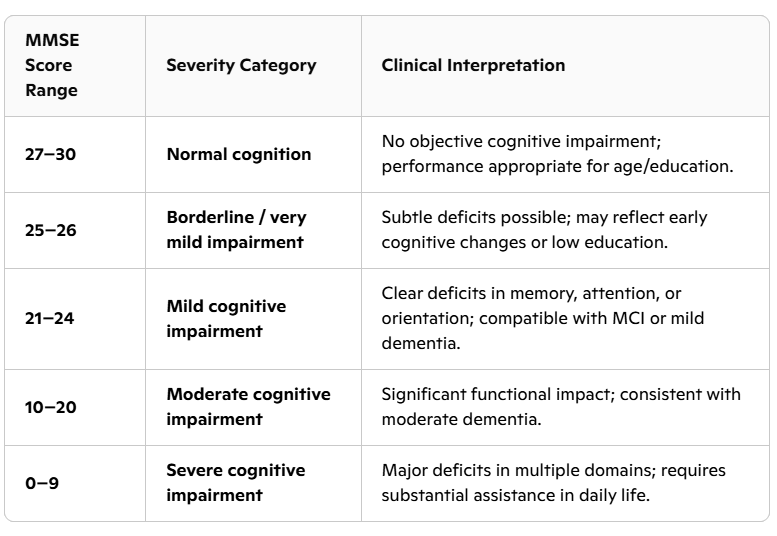
The ADAS-cog scores of the subjects in the placebo group deteriorated, while the scores of the supplementation group improved from moderate dementia to mild dementia. Both shifts were statistically and clinically significant.
Click on the figure and table below for a larger version.
![According to a somewhat older human study, supplementation with an extract of Salvia officinalis [better known as sage] can significantly improve the cognitive abilities of people with a moderate form of dementia. The dose required for this is entirely reasonable.](plaatjes/salvia-officinalis-cognition-1b.gif)
![According to a somewhat older human study, supplementation with an extract of Salvia officinalis [better known as sage] can significantly improve the cognitive abilities of people with a moderate form of dementia. The dose required for this is entirely reasonable.](plaatjes/salvia-officinalis-cognition-1.gif)
The second test the researchers used was the Clinical Dementia Rating - Sum of Boxes [CDR-SB]. This is a standardized questionnaire that practitioners must complete after speaking with the patient and caregivers.
The CDR-SB provides an overview of patients' functioning. Can they manage their own finances? Can they cook independently? Can they take care of themselves? How does their memory work? Do they still know where they are?
Here, too, the researchers observed a deterioration in scores in the placebo group and an improvement in the supplementation group. Here, as well, the improvement in the supplementation group was statistically and clinically significant.
![According to a somewhat older human study, supplementation with an extract of Salvia officinalis [better known as sage] can significantly improve the cognitive abilities of people with a moderate form of dementia. The dose required for this is entirely reasonable.](plaatjes/salvia-officinalis-cognition-2b.gif)
![According to a somewhat older human study, supplementation with an extract of Salvia officinalis [better known as sage] can significantly improve the cognitive abilities of people with a moderate form of dementia. The dose required for this is entirely reasonable.](plaatjes/salvia-officinalis-cognition-2.gif)
Side effects
As far as the researchers could see, Salvia officinalis had no side effects.
Conclusion
"The results of this study indicate the efficacy of Salvia officinalis extract in the management of mild to moderate Alzheimer's disease," the researchers summarize. "Further investigations to validate the results are necessary."