Study
Well, look at that. An RCT.
How wonderful is that? A genuine study with a control group, where the subjects are randomly assigned to the groups and do not know themselves whether they are receiving a supplement or a placebo.
And, moreover, this RCT is not sponsored. That is another plus. It doesn't matter that the authors left a typo in the title of their publication. We'll overlook that.
However, when we read the study, we soon discovered that it was not an RCT, but a pilot study. The researchers had given thirty postmenopausal women a tablet containing 100 milligrams of an extract from young Salvia officinalis leaves every day for four weeks. The extract is called Salvigol. Just before the supplementation began and on the last day of it, the women had completed a standardized questionnaire, based on which the Iranians gained an idea of the menopausal symptoms of their subjects.
We were able to find little information about Salvigol. We did, however, learn a bit about other products from the manufacturer, the Iranian Gol Daru Company. Gol Daru primarily markets hydro-alcoholic extracts of medicinal plants. They have extraction ratios that fall somewhere between 5:1 and 10:1.
That would imply that 1 tablet containing 100 milligrams of Salvigol is roughly equivalent to 500-1000 milligrams of dried Salvia officinalis. If you grind dried sage leaves into powder, that amounts to a quarter to half a teaspoon.

Strange findings
Results
The researchers found no statistically significant changes in heart rate, breathing, gloominess, headache, sexual desire, itching, crying spells, and interests.
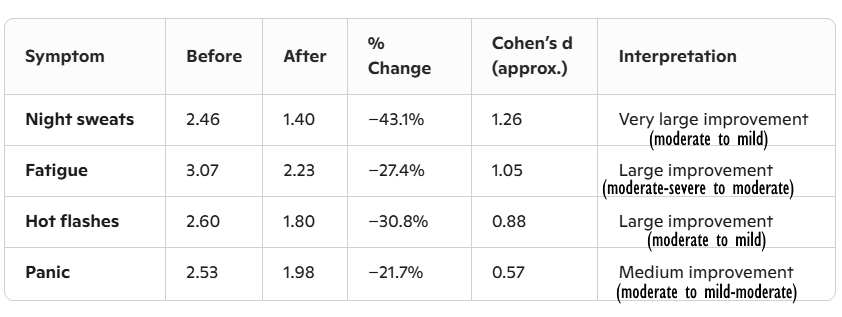
After four weeks of supplementation, the women did report a statistically significant improvement in night sweats, hot flashes, fatigue, and panic symptoms. The effect on night sweats was particularly strong, followed by a decrease in hot flashes and fatigue.
Click on the table below for a larger version.
Conclusion
We are continuing our search. More coming soon.