Study
The researchers divided the participants into 3 groups.
Participants in a first control group took a placebo daily for 12 weeks. Participants in a second control group took a supplement containing 66 milligrams of caffeine daily.
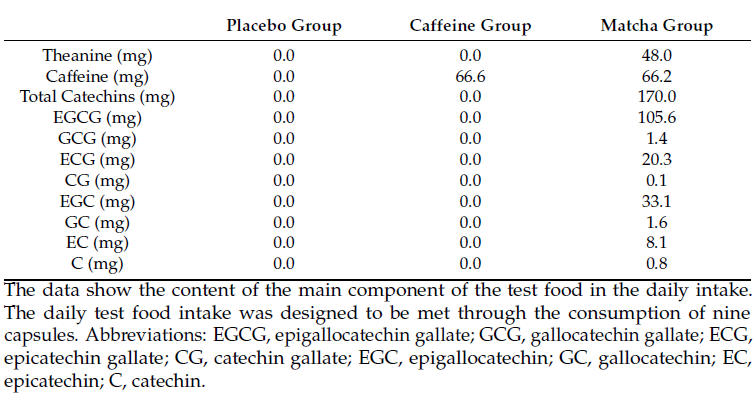
Finally, participants in the experimental group received a daily supplement containing 2070 milligrams of matcha powder. This supplement contained, among other things, 66 mg of caffeine, 48 milligrams of L-theanine, and 105 milligrams of EGCG.
Click on the table below for a larger version.
Results
The Japanese researchers did find an effect of 12 weeks of supplementation. They studied their subjects using multiple tests that provided information on memory, information processing, working memory, and emotion recognition, among other things, but they observed no noteworthy shifts on any of those tests.
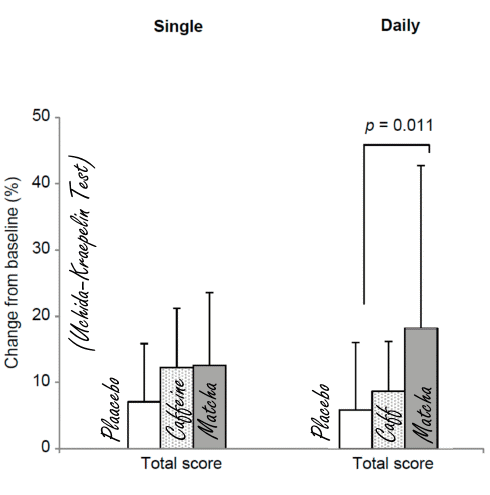
However, after 12 weeks, the Japanese researchers did find a statistically and clinically significant effect on the Uchida-Kraepelin Test. This test measures the ability to maintain mental focus and a certain work pace during mild stress.
In the Uchida-Kraepelin Test, subjects must solve as many addition problems as possible for half an hour straight. The more problems, the better—but every incorrect answer costs points. Matcha supplementation resulted in an improvement of roughly 15 percent in the average score on the Uchida-Kraepelin Test. That is comparable to an effect size seen in cognitive training.
Without supplements
2070 milligrams is the amount of half a teaspoon. This is enough to make a cup of matcha.
The researchers used matcha powder marketed as Hojin no Shiro. It is a product of ITO EN. The authors of the study were affiliated with the research department of that company. ITO EN therefore also funded the study.