
Epidemiological study
Based on food diaries filled out by the American participants, the researchers calculated approximately how many polyphenols the Americans consumed daily. Because the participants had also answered questions about sleep, the Chinese researchers were able to calculate whether there was a link between polyphenol intake and sleep.
And yes, there certainly was an association.
Results
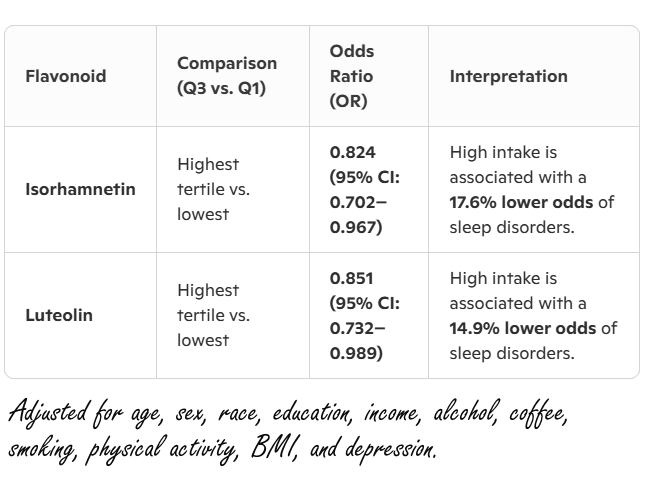
A relatively high intake of luteolin reduced the risk of sleep problems. To be more precise, the 33.3 percent [a tertile] with the highest intake of luteolin had about a 15 percent lower risk of sleep problems than the 33.3 percent [another tertile] with the lowest intake.
The flavonoid isorhamnetin provided even better protection. Americans in the tertile with the highest intake of isorhamnetin had nearly an 18 percent lower risk of sleep problems. Moreover, they slept a little longer.
Click on the table below for a larger version.
Luteolin versus isorhamnetin
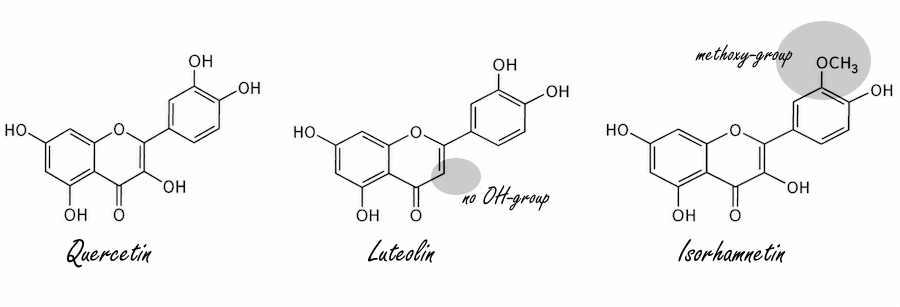
Luteolin, quercetin, and isorhamnetin are similar. We discussed the differences between the structure and pharmacokinetic properties of luteolin and quercetin a few days ago. You can see the difference in the planar chemical structure of the three molecules below.
Isorhamnetin has a methoxy group on the third carbon atom of the B-ring, whereas both luteolin and quercetin have a hydroxyl group.
This methoxy group inhibits enzymes that deactivate polyphenols in the bloodstream by attaching sugar groups to them. The same methoxy group also makes the molecule lipophilic, allowing it to enter the brain and penetrate brain cells more easily.
In foods
Here you will find a table that tells you how much luteolin is present in free and bound forms in foods. The table comes from a review published in 2017 in the International Journal of Agricultural and Life Sciences. [IJALS. 2017;3(2):195-207.]
A table is also circulating on the web that gives an idea of the concentration of isorhamnetin in regular foods. You can find it here. We have not been able to identify its scientific source.
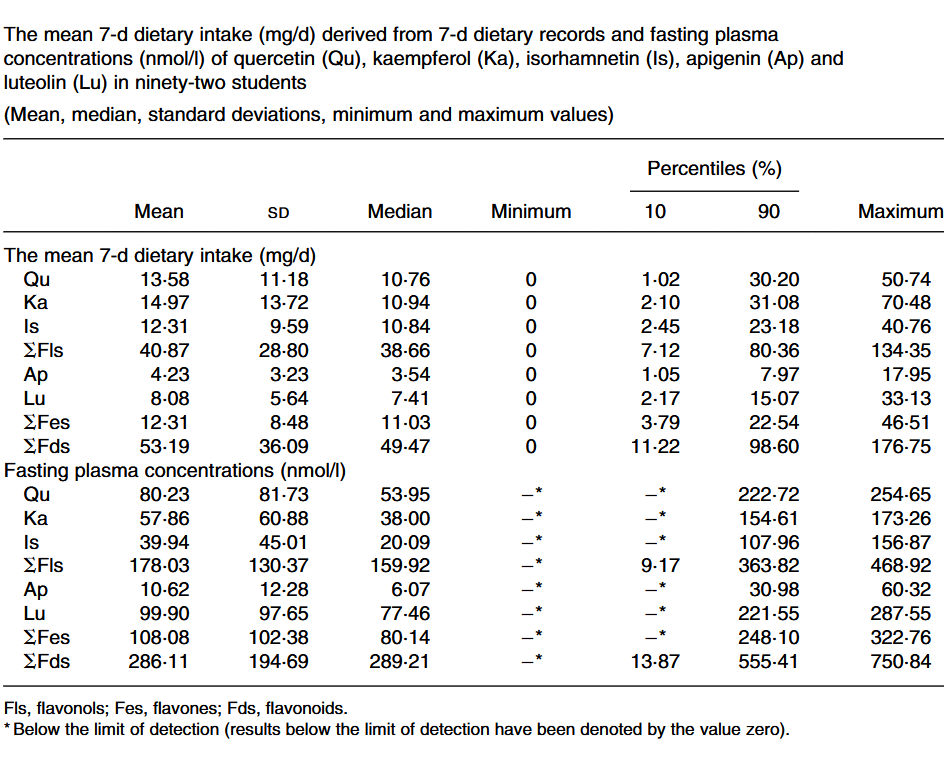
Only a few percent of all luteolin and isorhamnetin molecules are 'free' and therefore bioavailable. The rest are attached to sugar groups. Microorganisms in the gut cleave these groups off. Thanks to these microorganisms, the body can absorb approximately 18 percent of the molecules. In 2010, researchers from Harbin Medical University in China published an estimate of the daily intake of quercetin, luteolin, and isorhamnetin by students. [Br J Nutr. 2010 Jan;103(2):249-55.]
Although polyphenol intake in China is higher than in the West, the study provides an idea of what intake of luteolin and isorhamnetin is 'normal'.
The human equivalent of the dose of unbound luteoline that researchers administered to their test animals in the animal study we wrote about earlier was 15-25 milligrams.
If you take into account that almost all luteoline in the diet is bound and only 18 percent of that luteoline is ultimately absorbed in an unbound form, you realize that it is not possible to obtain that dose through regular food products.


