
Study
Mice in the control group [CTL] received only the sedative. Mice in an experimental group received a dose of luteolin orally half an hour before receiving the sedative.
The researchers wanted to know whether luteolin enhanced the effect of the sedative - and if so, to what extent. Substances that enhance the effect of pentobarbital in this experimental design often also have a positive effect on natural sleep themselves.
In another part of the animal study, the researchers determined how long the mice remained in deep sleep [NREM] after receiving luteolin. The body repairs itself, particularly during deep sleep.
Luteolin
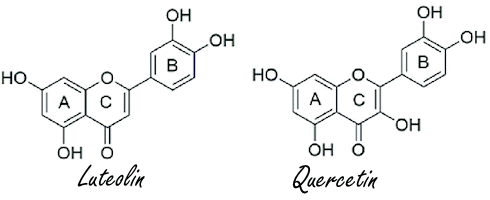
As a result, the antioxidant activity of luteolin in vitro is lower than that of quercetin. At the same time, the molecule is slightly less fragile than quercetin in vivo. In animal studies, the bioavailability of luteolin is a factor of 2-4 greater than that of quercetin.
Incidentally, apigenin also looks strikingly similar to quercetin. If you cut off not one but two hydroxyl groups from quercetin, you get apigenin.
Just saying.
Results
The researchers also looked at the effects of diazepam [DZP] on the sleep-promoting effect of pentobarbital. We will not discuss that.
The most effective dose of luteoline shortened the time to fall asleep and extended sleep duration by approximately thirty percent. The quantity of sleep therefore increased.
The human equivalent of the most effective dose was 15-25 milligrams. We have been poring over tables, but we have not been able to find a way to obtain that dose through regular food products. Fortunately, supplements containing that amount of luteoline are available in every online store.
Click on the tables below for a larger version.

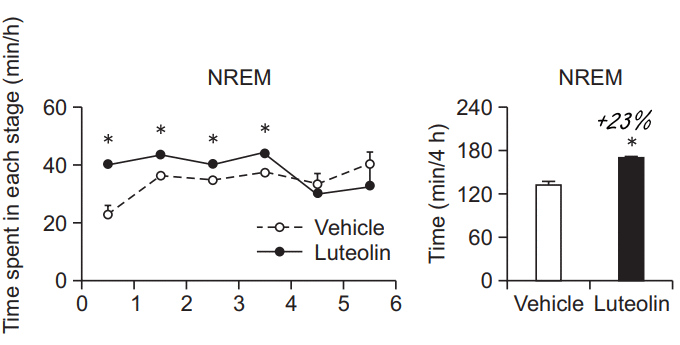
During NREM sleep, the brain produces delta waves. The intensity of those waves increased due to luteolin. This indicates that deep sleep became even deeper - so repair processes could proceed more thoroughly.
Mechanism
The researchers were able to determine that luteolin does not act via the receptors normally stimulated by GABA [an awkward term when it comes to GABA, we are aware of that], but via the adenosine receptors A1 and A2A.
These receptors are located in the neurons. During periods of wakefulness, astrocytes produce and release adenosine in the brain. As the concentration of adenosine in the vicinity of the neurons increases, sleep pressure rises. If that sleep pressure is high enough, you fall asleep.
Luteolin may increase the release of adenosine. Or perhaps it makes the receptors for adenosine more sensitive. Or it may do both.
Conclusion
"In conclusion, this study for the first time demonstrates that luteolin improves quantity and quality of sleep, especially for NREM in mice," the Koreans summarize.
"From these results, it is suggested that luteolin may have a potential for sleep-promoting agent."


