|
Definition: "An ergogenic aid is any substance or phenomenon that enhances performance "
|
|
||||||||
03.01.2014 |

|
|
Strength training makes sex still possible with prostate cancer
One in every six men will at some point hear from his doctor that he has prostate cancer. After this news many will start treatment with anti-androgens. These deactivate testosterone, thus inhibiting the growth of androgen-sensitive forms of prostate cancer.
The study that sports scientist Prue Cormie published in Prostate Cancer and Prostatic Diseases is interesting for these reasons. Cormie investigated whether a training programme could reduce the effects of anti-androgens on sexuality.
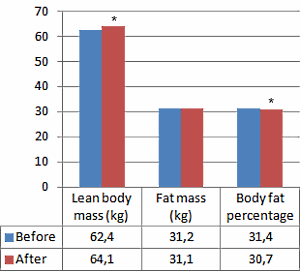
Cormie works at Edith Cowan University, where researchers are studying whether training programmes can help to reduce the side effects of anti-androgens. [Prostate Cancer Prostatic Dis. 2007;10(4):340-6.] One of the findings the researchers recently came up with is that a combination of strength and cardio training can help maintain muscle mass in men with prostate cancer [J Clin Oncol. 2010 Jan 10;28(2):340-7.] – even if the cancer has already spread to the bones. [Prostate Cancer Prostatic Dis. 2013 Dec;16(4):328-35.]
Some doctors are worried that strength training increases testosterone production, and as a result undermines anti-androgen therapy. The Australians discovered that this is not the case. [Prostate Cancer Prostatic Dis. 2008;11(2):160-5.]
Cormie studied a group of 57 men with prostate cancer who were just starting anti-androgen therapy. Of these 29 started training [Exercise] and the other 28 did not, forming the control group [Control].
Cormie got her subjects to train twice a week for an hour in a gym. Each workout started with a 5-minute warming up and finished with a 10-minute cool down, during which the men did low-intensity cardio training and stretches. The strength part of the workout consisted of eight exercises for the most important muscle groups. The men used weights with which they could manage 8-12 reps.
The researchers also encouraged the men in the Exercise group to walk or do exercises at home for 30 minutes on each non-training day.
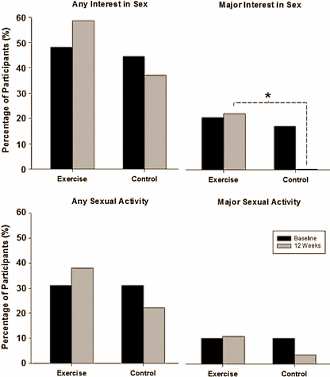
When the researchers specifically asked about the presence of strong sexual interest and sexual intercourse, they did find a significant effect. The number of men with a high libido went down to zero in the Control group; in the Exercise group the number remained stable.
Moreover, the men in the Control group had sex less often, and the men in the Exercise group had sex more often. These effects were not statistically significant either.
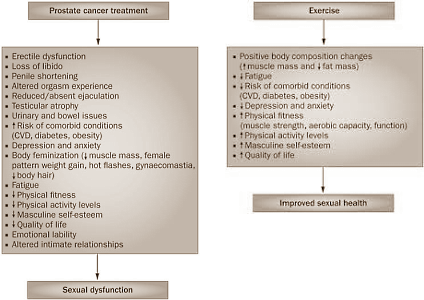
According to a review article that Cormie has published in Nature Reviews – Urology [Nat Rev Urol. 2013 Dec;10(12):731-6.], training improves sexual capabilities largely because it helps men regain a feeling of manliness. What's more, strength training reduces fatigue and improves cardiovascular condition.
"Participation in a short-term exercise program resulted in the maintenance of sexual activity in prostate cancer patients undergoing androgen-suppression therapy", the researchers conclude.
Source:
More:
Archives:
|
|
|||||||||||||||||