|
Definition: "An ergogenic aid is any substance or phenomenon that enhances performance "
|
|
||||||||
25.09.2013 |

|
|
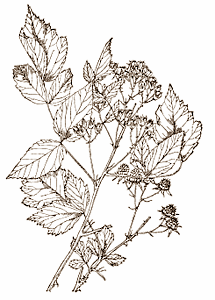
Rubus coreanus boosts endurance capacity and fights fatigue
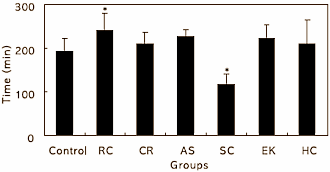
The endurance enhancing effects of Rubus coreanus were discovered in 2007. In that year Korean researchers at Chuncheon National University published the results of a study in which they had given mice six different alcohol-based plant extracts for a period of four weeks. The daily dose of the extracts was 500 mg/kg bodyweight.
At the end of the four weeks, the Koreans tied a weight to the end of the mice's tail and got the animals to swim to the point of exhaustion in an aquarium. The mice that had been given Rubus coreanus managed to swim for significantly longer than the mice in the control group, which had not been given any extracts.
The runner-up endurance enhancer was Acanthopanax sessiliflorus, although the improvement was not statistically significant. To read more about the performance enhancing effects of Acanthopanax sessiliflorus click here.
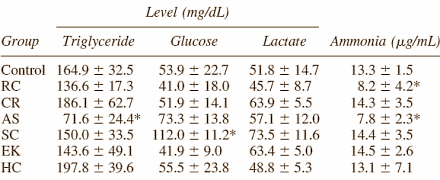
One of the effects of both Rubus coreanus and Acanthopanax sessiliflorus was that less of the protein waste product ammonia was found in the blood of the animals at the end of the session. More ammonia = more fatigue. It seems that Rubus coreanus improves combustion processes in the muscles, which means that muscle cells convert less protein into energy.
In 2011 other Korean researchers took another look at the performance enhancing effects of Rubus coreanus. [Biosci Biotechnol Biochem. 2011;75(2):349-51.]
These researchers got their mice to swim first until the point of exhaustion. The next day, before the animals had had a chance to recover, the mice were given extracts [water based, RCW, and alcohol based, RCE] that the researchers had made themselves from Rubus coreanus fruit, all in the same dose of 1 g extract per kg bodyweight. Half an hour later the researchers made the mice swim again. They observed that the alcohol-based extract lengthened the amount of time that the mice managed to keep their head above water.
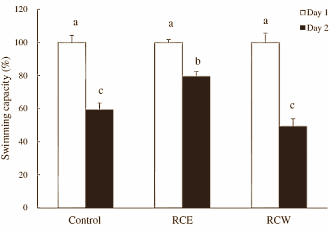
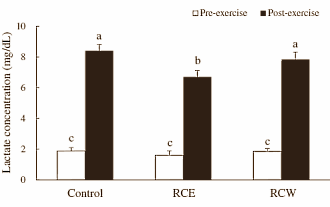
The figure above shows that these mice had less lactic acid in their blood after the swimming test. In the liver of the mice that had been given the alcohol-based extract of Rubus coreanus the researchers found more catalase and less glutathione and glutathione-S-transferase. This made them think that Rubus coreanus works by getting cells to produce more endogenous antioxidants.
Effective doses of Rubus coreanus for human endurance athletes would probably be around 4-5 g per day. If this is indeed the case, it'll be an expensive trick.
Source:
More:
|
|