|
Definition: "An ergogenic aid is any substance or phenomenon that enhances performance "
|
|
||||||||
03.09.2013 |

|
|
Pro-hormone version of trenbolone
Trenbolone is an expensive hormone. On the raw materials market a kilogram of trenbolone costs over six times as much as a kilogram of testosterone. This is because trenbolone, with three double bonds in its skeleton, is an anabolic steroid that requires considerable chemical gymnastics to produce.
The three double bonds make trenbolone a slim and flexible molecule, which fits better in the androgen receptor than testosterone does, better in the progesterone receptor than progesterone does, and above all is resists metabolization. That's why trenbolone is such an effective steroid – and why it's not without side effects. Take a look in Llewellyn's Anabolics. [amazon.com]
On the side effects: it may well be the case that in ten to twenty years we'll realise that these are more serious than we originally thought. Animal [Toxicol Sci. 2002 Dec;70(2):202-11.] and in vitro studies suggest that trenbolone can change DNA.
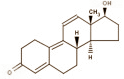
Above left is the trenbolone molecule in the form that is used for injectable preparations. Usually there's still one ester group attached.
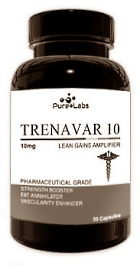
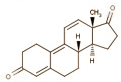
In the middle is trendione, the analogue that's turned up in the form of designer supplements. It is probably slightly active itself, but is also capable of partially converting itself in the body into fully active trenbolone.
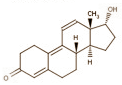
And above right is 17-alpha-hydroxytrenbolone or epitrenbolone. This substance is virtually inactive: it's by far the most important trenbolone metabolite that researchers detect in human urine.
The figure below is from the animal study we mentioned above. It shows the anabolic effect of injected [sc] and orally administered trenbolone [oral]. And orally administered trenbolone is active – but is a hundred times less active than the trenbolone given through a needle.
We compiled the figure below using data from the same study. It shows the effect of oral doses of 0 [olie], 0.1, 10.0 and 50.0 mg trenbolone per kg bodyweight per day on male rats incapable of synthesising testosterone.
The back row shows the effect on the muscles [levator ani], the second row from the back shows the effect on the prostate, the third row the effect on the seminal vesicles and the front row shows the effect on the penis.
The values on the y-axis are in milligrams.
So oral trenbolone is active, and oral trendione is probably active too.
If you convert the dose of 10 mg/kg/day to the dose for an adult human weighing 80 kg, then you'd need about 130 mg per day. Steroids expert HenryV – clever, knowledgeable, active on the better bulletin boards and writer of superior posts – suspects however that people react better to oral trenbolone, and therefore also to trendione, than rats do.
He compiled it from an animal study in which researchers analysed trenbolone metabolites in the gall bladder of rats [Xenobiotica. 1981 Jul;11(7):489-500.] and PhD research done by a Dutchman, Douwe de Boer. [Biol Mass Spectrom. 1991 Aug;20(8):459-66.] These studies suggest that rats neutralise trenbolone faster than humans do, and that humans therefore probably need less trendione than you'd expect based on the animal studies.
The first reports from users seem to confirm HenryV's view. Users have reported anabolic effects at doses of 40 - 90 mg trendione per day. At the higher dose androgenic side effects come into play.
Source:
More:
|
|