ergo-log.com

Definition: "An ergogenic aid is any substance or phenomenon that enhances performance "

about us

/

contact

/

18.01.2012


Does Q10 offer strength athletes cardiac protection?

Athletes who do strength sports develop an enlarged heart. This is not a problem in itself, but when combined with anabolic substances this enlargement can result in a fatal abnormality. Taking a Q10 co-enzyme supplement may offer protection, if the results of studies published by American cardiologists in the 1990s are anything to go by.


Doing strength sports can cause an enlargement of the left ventricle in the heart. The muscles in this ventricle – in the septal wall and the posterior wall to be precise – that it leads to a reduction in the amount of blood that the ventricle can pump round the body.

Cardiologists observe this phenomenon primarily in people with high blood pressure, but occasionally chemical strength athletes also develop a dangerous form of left ventricular hypertrophy.

According to a 2003 Finnish study, it's steroids users who also make long-term use of growth hormone that should be worried. [Int J Sports Med 2003; 24: 337-343.] The amount of blood that the heart is capable of pumping round the body can reach dangerously low levels in this group.

The American cardiologist Per Langsjoen has been publishing articles regularly since the 1980s on the cardiological effects of Q10. In the 1990s Langsjoen focused on people – not strength athletes – with an enlarged left ventricle. We dug up a small study that he did in 1997, in which he got seven patients to take an average of 200 mg Q10 every day for 3-48 months.

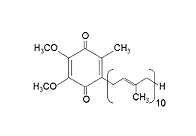
Q10 [chemical formula shown here] is a molecular thumbtack, which functions as a distribution centre for electrons. If the cell pushes enough of these into the mitochondria membranes, they can generate energy faster and cells take longer to reach the point of exhaustion.

Left ventricular hypertrophy is believed to be caused by heart cells becoming chronically fatigued. Langsjoen reasoned that heart cell vitality could be restored through supplementation aimed at reducing the negative effects of left ventricular hypertrophy.

And hey presto: the table below shows that the subjects' septal wall thickness [SWT] and the posterior wall thickness [PWT] decreased.


EF slope, LVEDD and FS are cardiological variables which indicate how well the heart is pumping blood. The results show an improvement, but it's not statistically significant. Nevertheless, the patients had less chest pain, were less tired and less short of breath.

"These highly encouraging clinical and echocardiographic findings in hypertrophic cardiomyopathy are in keeping with the working hypothesis that CoQl0 has a beneficial effect on myocardial bioenergetics and ATP production", the researchers conclude.

In 1999 Australian cardiologists published the results of a study which showed that Q10 supplementation had no effect on the left ventricle of patients. [J Am Coll Cardiol. 1999 May; 33(6): 1549-52.] They used a lower dose than the Americans.

Source:
Mol Aspects Med. 1997;18 Suppl:S145-51.

More:
Proper breathing technique doesn't make you less strong 04.06.2011
Strength training with light weights stiffens arteries, half an hour of cycling works better 25.03.2011
Only strength training of upper body stiffens arteries 16.03.2011
Stretching vs. artery stiffening 09.03.2011
Cardio session after strength workout keeps arteries supple 08.03.2011
Creatine keeps strength athlete's arteries supple 07.03.2011
Strength training stiffens arteries 06.03.2011
Drinking water protects against fatal heart attacks 23.08.2009
Cardio drugs protect heart against anabolic steroids 16.06.2009
Heavily taxed heart beats more slowly with fish oil 28.05.2009
Afternoon nap halves risk of fatal heart attack 06.12.2008
How fish oil can help prevent heart attacks 02.11.2008