|
Cyclists bike faster with paracetamol
The over-the-counter painkiller paracetamol, also known as acetaminophen, has a performance-enhancing effect. Sports scientists at the University of Exeter in England gave trained cyclists 1.5 g paracetamol and found that they took 30 seconds off their time for a 10-mile trial.
Paracetamol
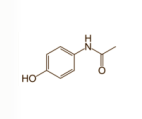
Paracetamol [structural formula shown here] is the most widely used painkiller in the world. It's been in use since the late nineteenth century, but even so scientists don't know how paracetamol works. One theory is that paracetamol inhibits cyclo-oxygenases, the enzymes that are active in the inflammatory reactions that cause pain. Another theory is that paracetamol sabotages the nerve pathways along which pain signals travel.
The Brits were interested to know to what extent successful athletes have to overcome pain. Performance means pain, they theorise, and the ability to overcome pain is a success factor in sport.
Study
If their theory holds water, then painkillers should help trained cyclists to achieve better times. So the researchers got 11 competitive male cyclists, aged 26 and recruited from local cycling clubs, to do a 10-mile/16.1-km trial twice: on one occasion they took a placebo and on the other 1.5 g paracetamol. The cyclists started 45 minutes after taking the painkiller or placebo.
Results
And lo and behold. When they'd taken the placebo the cyclists did the 10 miles in 26 minutes and 45 seconds, after taking the paracetamol their time was 26 minutes and 15 seconds. That's a statistically significant difference.
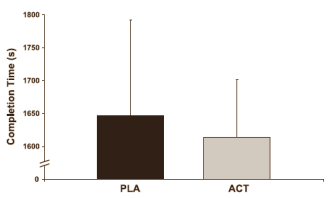
The researchers measured the cyclists' power output during the trial. In other words: how fast the cyclists pedalled. They noticed that the cyclists consistently pedalled slightly faster when they'd taken a painkiller.


The researchers also asked the cyclists how much pain they'd felt and how tired they became during the trial. Here they noticed no effect, apparently because when the cyclists had taken a painkiller they continuously pedalled faster, and so were up against their pain threshold.
Conclusion
It's certainly an interesting study, but we have a few problems with it. Paracetamol has a bitter taste, that's almost impossible to mask. If you take 1.5 g paracetamol you notice it. So the cyclists probably knew whether theyd taken a placebo or a painkiller. So mightn't the 30-second gain have been caused by an uncontrolled placebo effect?
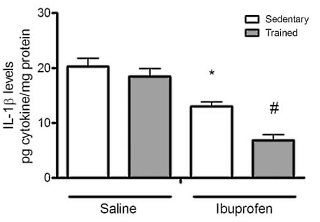
If you're thinking of experimenting with paracetamol, bear in mind that painkillers like paracetamol and ibuprofen inhibit post-training muscle growth in young people. [J Clin Endocrinol Metab 2001 Oct;86(10):5067-70.]
Source:
J Appl Physiol. 2010 Jan; 108(1): 98-104.
More:
Paracetamol improves sprint series performance 16.12.2013
Paracetamol softens the realisation that we are mortal 07.11.2013
One gram paracetamol reduces your hurt feelings 29.10.2013
Archives:
Endurance Drugs
Paracetamol
Pain Killers
|