|
Evening workout won't cost you sleep
You'll have a good night's sleep even if you were sweating it out in the gym at nine that evening. Sports scientists at the University of Jyvaskyla draw this conclusion in a study published in the Journal of Sleep Research. The standard advice not to do intensive physical exercise less than three hours before going to bed needs tweaking.

Sleep for athletes
Sleep is of great importance to athletes. The better you sleep, the better your oxygen uptake, the easier it is to build up muscles, the higher your testosterone level, the more successful weight loss is likely to be, and the longer you are likely to live. And, the better you sleep, the more attractive you are.
Athletes are well aware of the importance of sleep. But a search for ways to improve quality of sleep soon reveals a problem. Nearly all non-scientific articles on sleep emphasise that exercising before going to bed will reduce the quality of your sleep. So no training in the evening is the message.
Sounds simple, but not always practical. Sometimes it's impossible to get to training before nine in the evening.

Study
The researchers from the University of Jyvaskyla are aware of this dilemma and decided to do an experiment to find out whether evening workouts really are so detrimental to sleep. They got 11 people in their twenties to sleep for two nights in a laboratory where they measured quantity and quality of the subjects' sleep.
On one of the two nights the subjects did no sport, on the other they cycled to the point of exhaustion between 21:00 and 22:00. They cycled on an ergometer until they could no longer pedal. The researchers stepped up the resistance every three minutes so that the subjects had to 25 Watts more. [So they had to pedal harder each time.]
Results
The table below shows that the workout had no effect on the subjects' sleep. On the day that the subjects had cycled [Exercise day] they even went to sleep a little earlier than on the day that they had not exercised [Control day]. The difference was not significant, however. On the exercise day the subjects slept a little longer than on the control day, but again the difference was not significant.
The exercise did lead to an increase in non-REM sleep. This effect was statistically significant, but does not imply a deterioration.
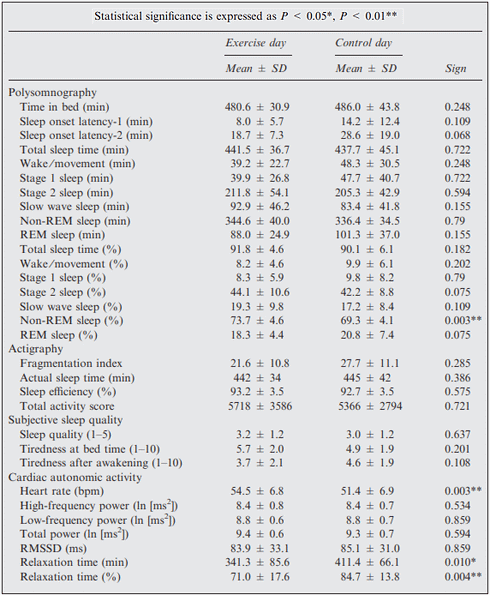
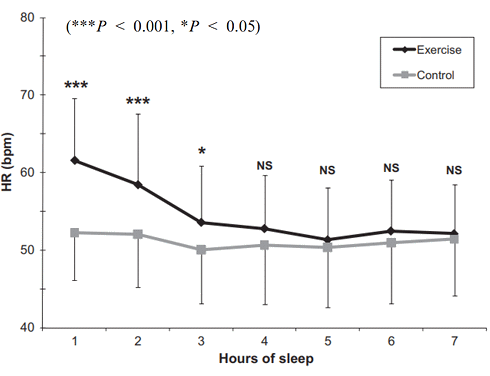
Lastly, the researchers discovered that during the first three hours of sleep on the exercise day the subjects' heart rate was significantly higher. The figure above shows this.
Conclusion
The researchers don't think this means that the body recuperates less well during sleep. But, they admit, we don't have sufficient scientific knowledge to be able to say anything about this.
Source:
J Sleep Res. 2011 Mar;20(1 Pt 2):146-53.
More:
Yoga, walking, cardio training | All types of physical activity improve sleep 20.01.2023
A little extra exercise lifts you out of sleep poverty 11.09.2022
Exercising outside during the day improves sleep 20.02.2022
Sleep better - do strength training 24.05.2015
Exercising outside during the day improves sleep 09.03.2013
Archives:
Sleep
|
|


